
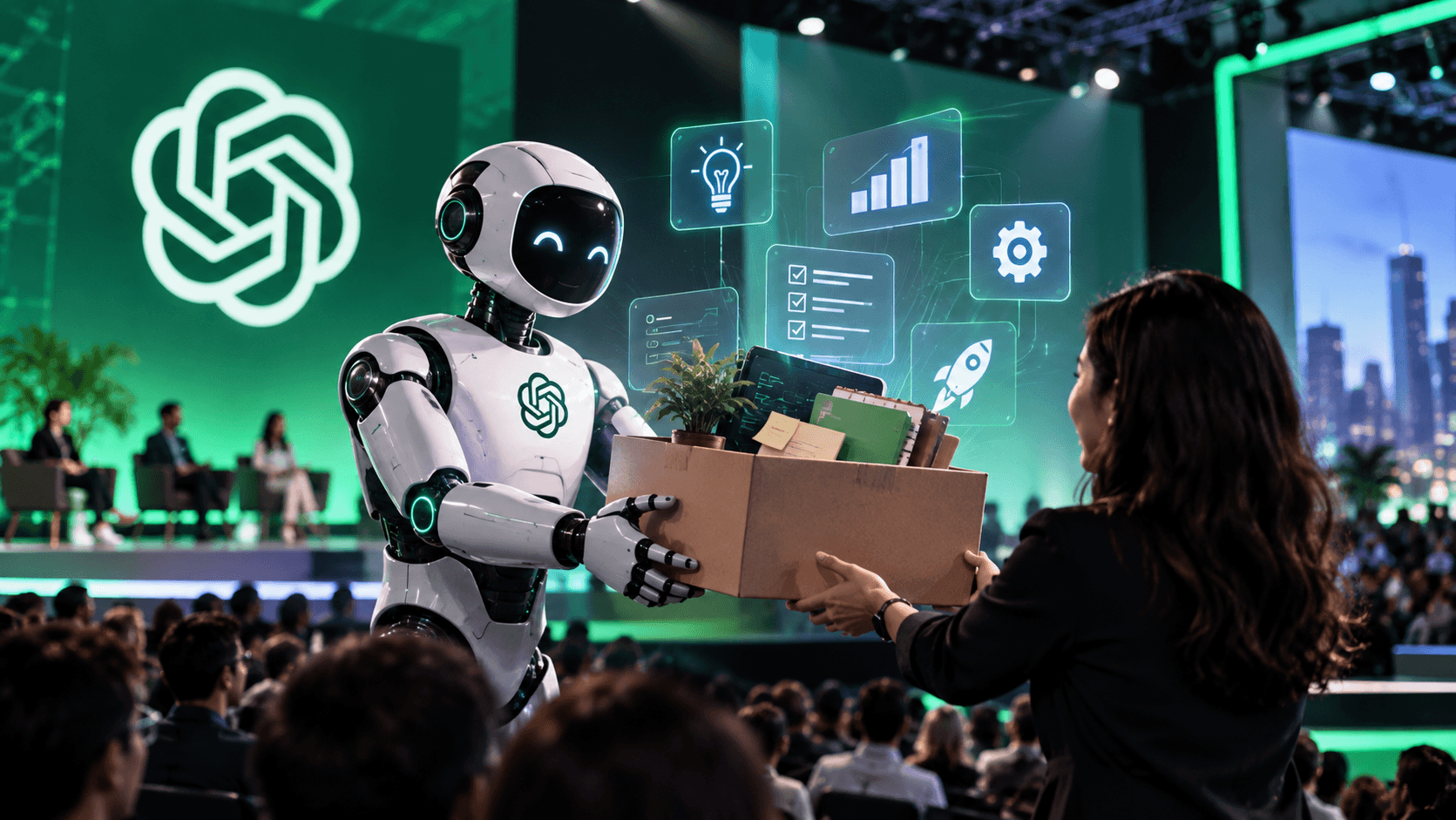
When Your Roadmap Becomes a Platform Feature: Building AI Startups That Last
As foundation model companies ship new capabilities every few months, AI founders face a harder question than "can we build it?" They now have to ask whether they can still own it.
For today's AI founders, the most dangerous competitor may not be another startup. It may be the very platform their product runs on. Every major launch from OpenAI, Anthropic, or Google brings the same uncomfortable question: what if the feature your team spent a year building simply shows up as part of the model?
The New Competitive Reality
Not long ago, AI startups mostly worried about rival startups. Now they are up against foundation model providers that roll out entirely new capabilities on a regular cadence. That shift is changing how companies think about product strategy, fundraising, and valuation across the whole AI ecosystem.
Almost every strategic call is affected: what to build, where to stand out, how to pitch investors, and how to create value that lasts. The core question has moved from technical feasibility to ownership. Building something impressive is no longer enough if a platform update can make it redundant overnight.
When Products Turn Into Features
One of the biggest risks for AI startups is not being outcompeted by another founder. It is waking up to find that your key advantage has become someone else's product update. As models improve quickly, capabilities that once set a startup apart can turn into basic expectations that every user takes for granted.
The companies that win in this environment may not be the ones with the smartest models. They are more likely to be defined by the things a model cannot easily replicate. The test founders need to apply is simple but demanding: will customers still value what we have built after the next big model release?
Three Lenses on AI Defensibility
This challenge is being examined by three industry leaders who bring different vantage points: a founder, an operator, and an investor. Each focuses on a different part of the same problem.
The founder's view. Michel Tricot, CEO and co-founder of Airbyte, has spent his career building the data integration infrastructure behind analytics, operations, and AI. His open-source platform now serves more than 7,000 customers, including 18% of the Fortune 500. His focus is on how to create lasting value when the technology beneath your product never stops changing, and where durable businesses exist beyond the model layer.
The operator's view. Linda Tong, CEO of Webflow, is guiding one of the leading visual development platforms through one of the largest technology shifts SaaS has seen. Drawing on her experience scaling Webflow and leading teams at Google, Cisco, and the NFL, she looks at how software companies can evolve their products as AI changes customer expectations, without losing their competitive edge.
The investor's view. Rob Toews, a partner at Radical Ventures, assesses AI startups daily. His lens is what convinces investors that a company will still be relevant three years from now, and where products are at risk of being absorbed as features.
The biggest risk for an AI startup isn't building a weak product. It's building a strong one that ends up as someone else's feature.
Building Beyond the Next Model Release
Foundation models will keep getting better. That part is certain. As OpenAI, Anthropic, and others expand what their systems can do, every founder has to decide how their company will continue to stand apart.
The AI leaders of tomorrow will likely be the companies customers keep choosing for reasons a model cannot replicate: the workflows they enable, the data they hold, the problems they solve, and the trust they have built. Instead of reacting to each new release, founders should focus on where defensibility genuinely exists, what enterprise and startup buyers still value, and how to build a business that stays relevant as AI keeps moving.
The question is not whether foundation models will evolve. It is whether your company will keep creating value as they do.
- Platforms are now competitors. Foundation model providers can absorb a startup's core offering with a single release.
- Ownership matters more than capability. The key question has shifted from "can we build it?" to "can we still own it?"
- Moats live outside the model. Proprietary data, embedded workflows, customer relationships, domain expertise, and trust are the hardest things to replicate.
- Investors are thinking long term. The bar is proof that a company will still matter three years out, not just a strong demo today.
- Build businesses, not features. Lasting AI companies solve real problems customers keep paying for, no matter how the underlying models change.