
How a Bengaluru Drone Startup Wants to Out-Price Trucks
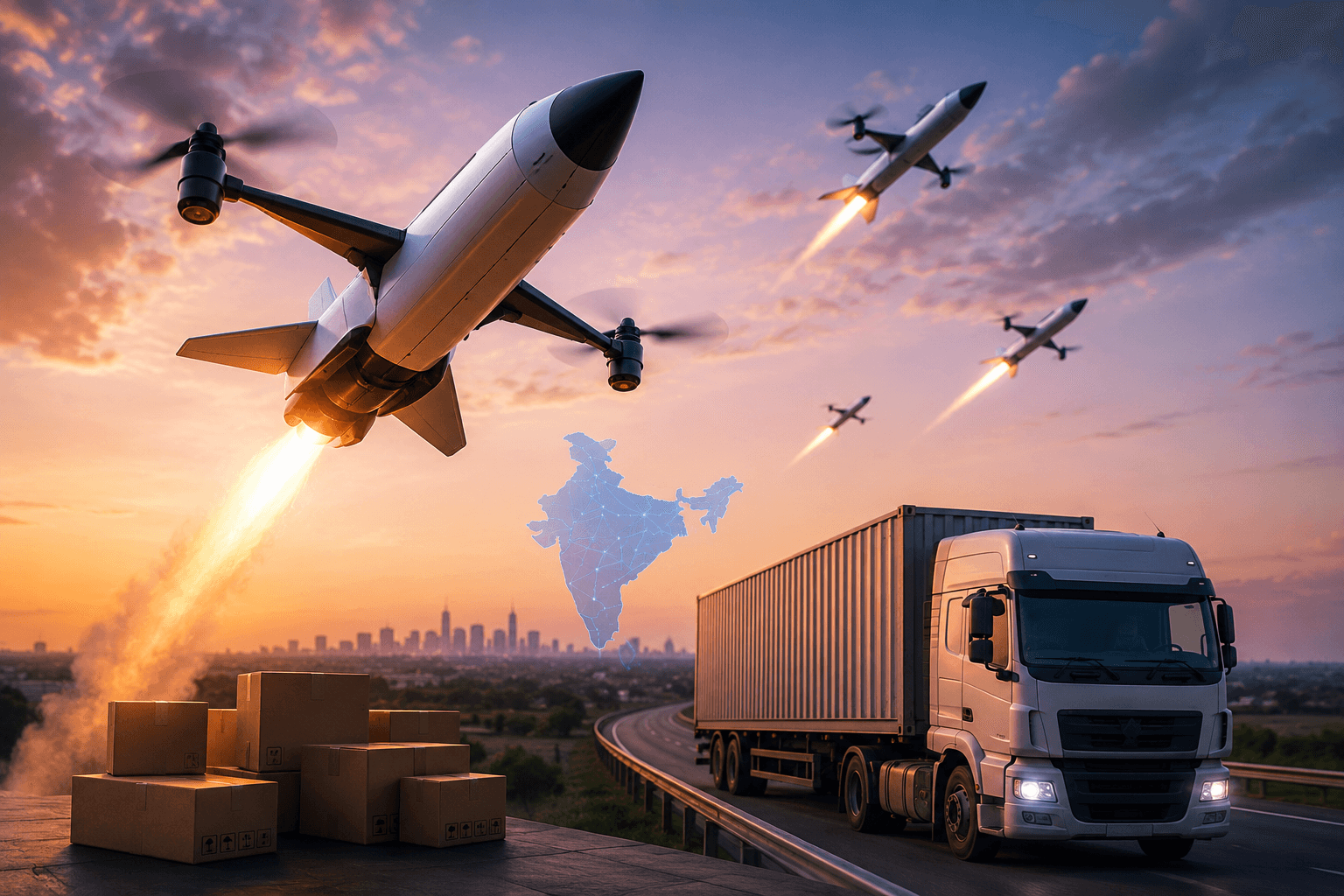
A Bengaluru-based aerial logistics company has closed a fresh funding round to scale its featherweight, rocket-style delivery drones, betting that lighter aircraft can finally make air cargo as cheap as road freight.
A startup building ultra-light, vertical-takeoff delivery drones has pulled in significant new backing, arguing that shaving weight off the aircraft itself — not just the cargo — is the real key to making drone delivery cheaper than a truck.
Betting on Featherweight Aircraft
The company just closed a Series A round backed by a well-known growth investor along with a major food-delivery platform, a prominent Silicon Valley angel, and two venture firms. The raise lands less than a year after an earlier seed round, pushing the young company's total funding close to the $50 million mark.
The core pitch is straightforward but hard to execute: most aircraft burn the bulk of their energy simply hauling their own weight, which makes flying small parcels prohibitively expensive. So instead of scaling up a traditional drone, the founder set out to build a flying vehicle that weighs less than what it's carrying. The current model tips the scale at roughly 3.3 pounds while lifting about 2.2 pounds of cargo, and a heavier successor now in development is expected to weigh around 6.6 pounds while carrying up to 11 pounds.
Each aircraft launches and lands like a small rocket — nose up, then tipping into forward flight once airborne — a tail-sitting design chosen specifically so the fleet never needs a runway, even as the vehicles get bigger.
Already Flying for Hospitals
Founded in 2023, the company has logged more than 13,000 autonomous flights across two southern Indian cities, and over 1,000 of those have been for a hospital network that uses the drones to shuttle diagnostic samples between facilities. On that route, a single active drone covers about 2.5 miles in roughly seven minutes — a trip that can otherwise take three to five hours by road once the wait to bundle enough samples for a truck run is factored in.
That hospital partnership is now expanding to a newly built facility that was designed without its own diagnostic lab or blood bank, relying instead on the drone network to connect it to centralized testing centers.
The ambition here isn't to run the biggest delivery service — it's to become the aircraft maker that every logistics operator eventually builds on, the way commercial airlines build on a handful of aircraft manufacturers rather than each building their own planes.
Revenue Can Wait
Despite the flight volume and a headcount that has grown past 150 people, the company remains largely pre-revenue, a position the founder frames as deliberate rather than a warning sign. With regulatory approvals still the gating factor for commercial-scale operations, the near-term focus is on proving the network works technically before pushing hard on monetization. The stated goal, in the founder's own words, is to become a major player over decades rather than chase revenue on a short timeline — a stance that will be tested as competitors in India's aerial logistics space, including other homegrown drone makers, push their own delivery ambitions forward.
- Lightweight design is the core innovation. Building drones that weigh less than their payload, rather than just adding bigger batteries, is the company's main bet for reaching cost parity with trucking.
- Funding has nearly tripled in under a year. The jump from an $8.65 million seed round to a $37 million Series A signals strong investor confidence in the aerial logistics thesis.
- Healthcare is the current proving ground. Diagnostic sample delivery for a hospital network already cuts a multi-hour truck trip down to about seven minutes by air.
- Regulation, not hardware, is the ceiling. Beyond-visual-line-of-sight approvals remain the critical unlock for scaling from hundreds to thousands of daily flights.
- The long game is infrastructure, not delivery. The company positions itself as an aircraft builder for other logistics networks, rather than an operator competing to run the most deliveries itself.