
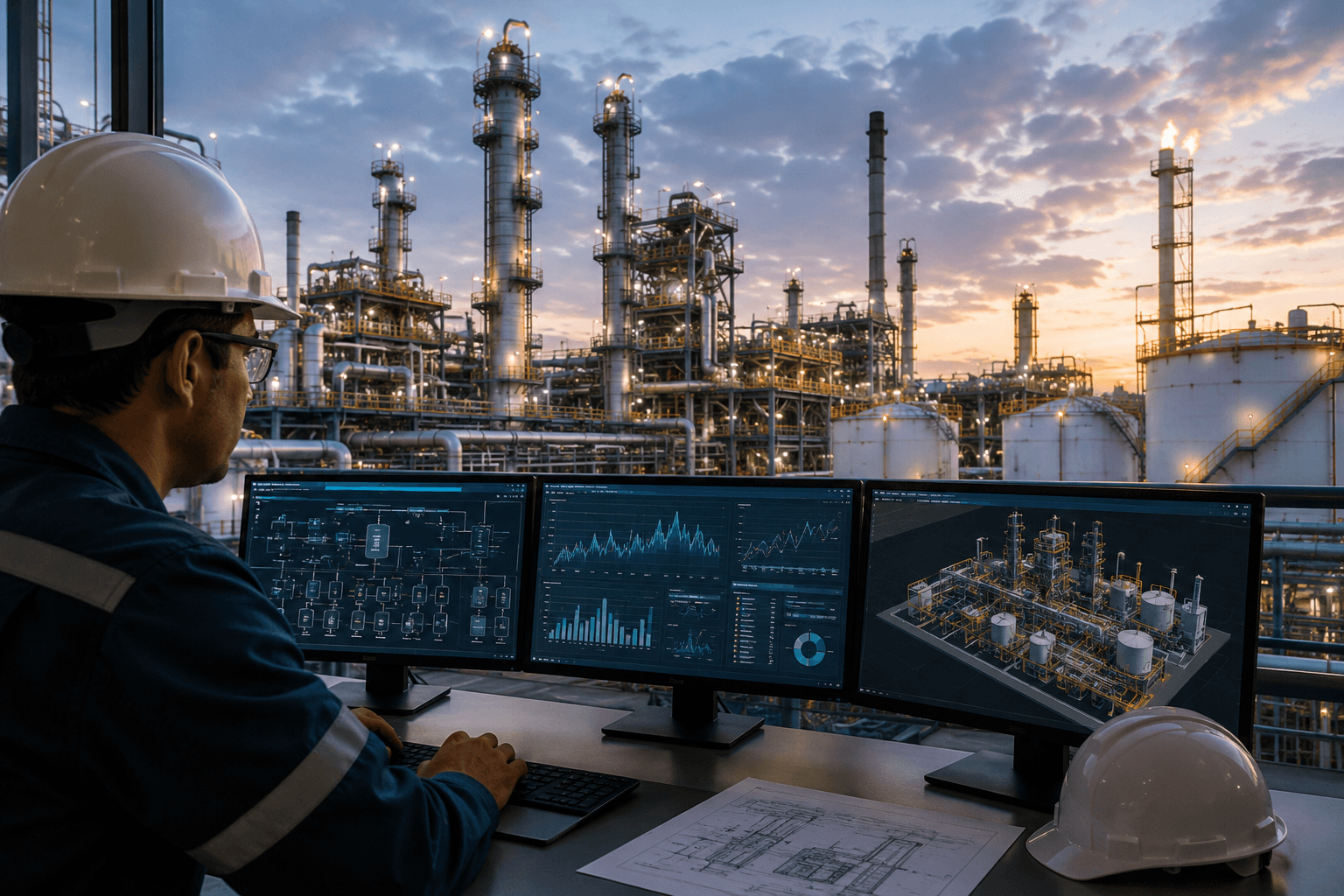
Startup Lands $20 Million To Build A Single AI Brain For Entire Energy Plants
A young startup is tackling one of heavy industry's oldest inefficiencies — plants that collect enormous amounts of sensor data but barely use any of it — by fusing physics, language, and time-series models into one system built specifically for oil, gas, and petrochemical operations.
A London-founded startup building artificial intelligence for heavy industry has closed a new funding round led by a major engineering firm, betting that oil, gas, and petrochemical operators are sitting on far more data than they know what to do with.
Thousands Of Sensors, Barely Any Insight
A modern refinery or chemical plant can be wired with thousands of sensors tracking everything from temperature and pressure to fluid velocity and viscosity. Yet according to the company's leadership, facilities typically make decisions using less than a tenth of the information available to them. The bottleneck isn't a lack of data — it's the difficulty of getting sensor readings, engineering documentation, and the underlying physics and chemistry to work together fast enough to be useful in the moment.
Three Models Fused Into One
Rather than relying on a conventional large language model, the company built its system — internally called Orbital — around a blend of three approaches at once: a time-series model to track sensor patterns, a physics-based model to respect real-world equipment constraints, and a language model to interpret documentation and operator activity. The combination is designed to let the system understand not just what a plant's readings say, but what those readings mean physically, and what might happen if something changes.
A Crowded Field, But A Different Bet
The industrial software space the company is entering is far from empty. Established players already sell simulation and modeling tools for upstream, refining, and chemical operations, while others focus specifically on organizing and analyzing industrial data. The company's leadership argues its real advantage isn't access to proprietary plant data or process expertise, but its ability to recruit top AI research talent — talent it believes energy incumbents themselves would struggle to attract. Real-world operational data from working plants, which is largely unavailable publicly and can't be fully replicated through simulation, is described as another edge that grows stronger with each new customer deployment.
This is fundamentally an AI research problem, not a data or energy problem — and the best AI researchers aren't going to choose to work at a traditional energy company.
The fresh capital is earmarked for international expansion, additional research and engineering hires, and new deployments with energy customers. Beyond its engineering-firm partner, the company has also worked with a major Indian energy company, is engaged with a large U.S. upstream operator, and expects to announce a partnership with a European oil major in the near future.
- Most industrial data goes unused. Facilities reportedly rely on less than a tenth of the sensor data they already collect to make operating decisions.
- The technical approach blends three model types. Combining time-series analysis, physics-based modeling, and language understanding is the company's answer to that fragmentation.
- Speed is the core sales pitch. Compressing multi-week fault investigations into minutes is positioned as the product's biggest value driver.
- An engineering giant is both investor and customer. Having a partner integrate the technology directly into its own industry platform lends credibility and distribution at once.
- Talent, not data access, is the stated moat. The company argues that recruiting elite AI researchers — not owning proprietary plant data — is what will separate it from competitors.