
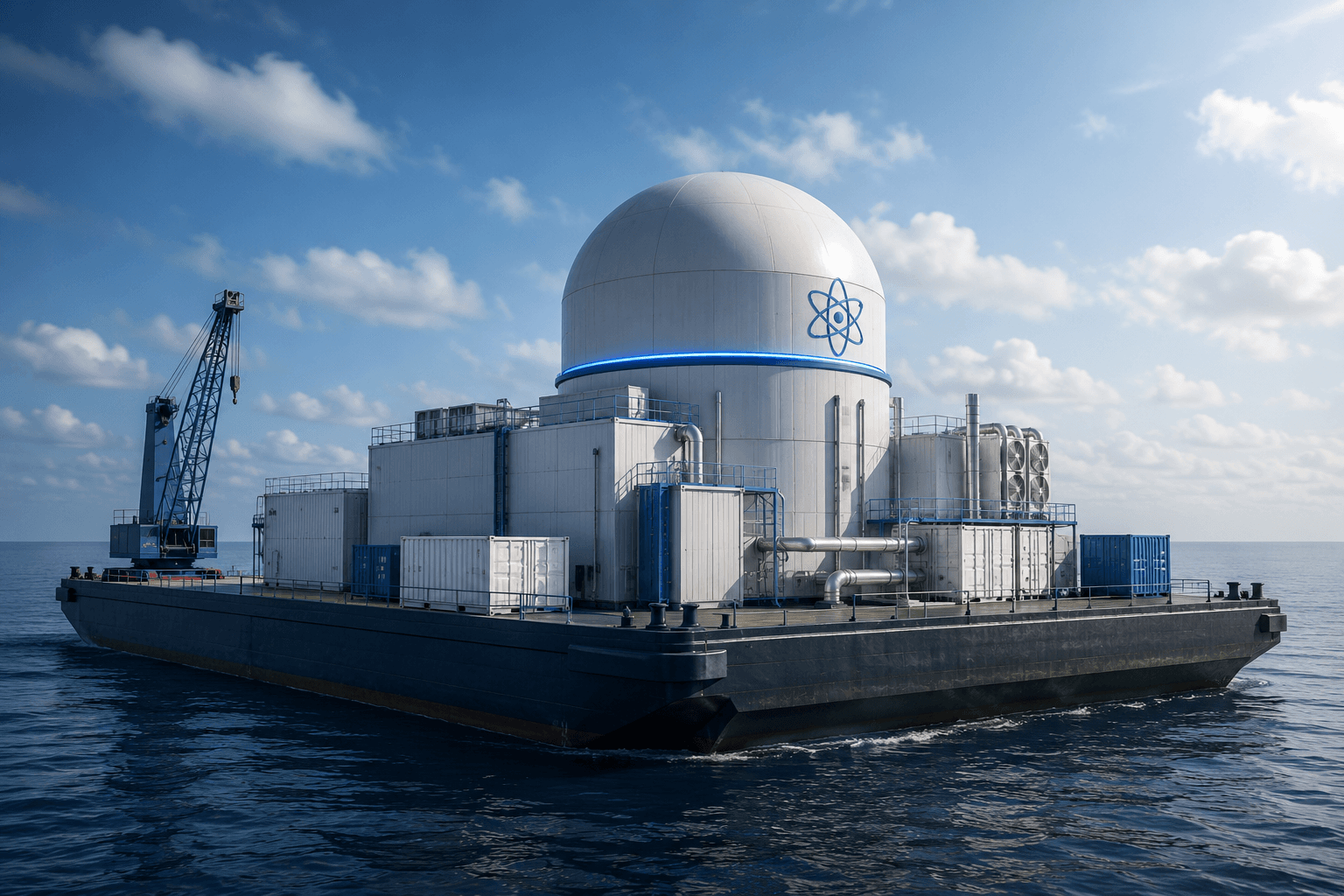
Former Uber Freight Exec Raises $10M to Put Nuclear Reactors on Barges
A young maritime energy venture has landed pre-seed backing to develop floating small modular reactors designed to deliver clean power to ports, coastal communities, and data-hungry infrastructure.
A new player in the maritime energy space wants to solve the clean power puzzle by putting small nuclear reactors on the water instead of on land — and investors are already buying into the vision before the company has even marked its first birthday.
From Freight Logistics to Floating Reactors
The company behind this ambitious pivot into nuclear energy was founded less than a year ago by a founder who spent time at Uber's freight division before setting his sights on the power grid. The idea: build compact nuclear reactors that live on barges rather than fixed land sites, so that clean electricity can be floated directly to wherever it's needed most — starting with ports.
The pitch clearly resonated with backers. The pre-seed round was led by an investment firm called Slauson & Co., with additional participation from Harlem Capital, Precursor Ventures, Ripple co-founder Chris Larsen, and entertainer Kevin Hart's venture fund, alongside a handful of angel investors.
How the Technology Actually Works
The system relies on small modular reactors (SMRs) that heat water to produce steam, which then drives a turbine-generator to create electricity — a closed-loop, water-cooled setup similar in principle to nuclear plants that have safely operated for more than seven decades. The key innovation isn't the physics; it's the packaging. By mounting the entire generation system on a barge, the startup can ship power to a new location by sea rather than building new transmission infrastructure on land, which the founder says effectively eliminates transport-related emissions.
Another selling point is refueling frequency. According to the founder, the complete power system needs to be refueled only once every several years, reducing the operational overhead compared to constantly resupplied generation sources.
Docking Near Ports — and Eventually Data Centers
The barges are designed to dock near coastal communities and connect into the power grid using subsea cables, with an initial goal of generating enough electricity to power roughly 15,000 homes, or to meet the needs of a major port on its own. That scale positions the technology as a potential bridge between clean energy generation and the surging electricity demand created by the AI boom.
The founder noted that data center operators have told him they'd prefer not to draw water or power away from surrounding communities if they had access to a dedicated offshore source of both electricity and water. Floating nuclear barges, in that framing, could let AI infrastructure scale without straining local grids.
Floating nuclear power isn't about reinventing physics — it's about rethinking delivery. When clean energy can travel by sea instead of requiring new land infrastructure, the barriers to scaling it start to look very different.
What Comes Next
With fresh funding in hand, the company plans to move from concept to deployment. It has already lined up a port terminal, a barge, and a test reactor pressure vessel that will be used to simulate the water-based cooling flow central to the system's design. The team says it's combining hardware testing with software validation to confirm the design before working further with regulators to build out what it calls the "safest design decision" for its first commercial product.
- A fast-moving pre-seed bet. The startup closed $10 million in funding just seven months after being founded.
- Proven tech, new packaging. The reactors use decades-old, water-cooled nuclear technology, repackaged for mobility on barges.
- Zero-emission relocation. Moving power generation by sea instead of building new land transmission lines is central to the emissions pitch.
- Safety-first regulatory approach. The company is working with regulators and layering physical safeguards like steel and concrete shielding around the reactor core.
- Eyes on the AI power crunch. Offshore nuclear barges are being pitched as a way to meet data center energy demand without straining community grids.