
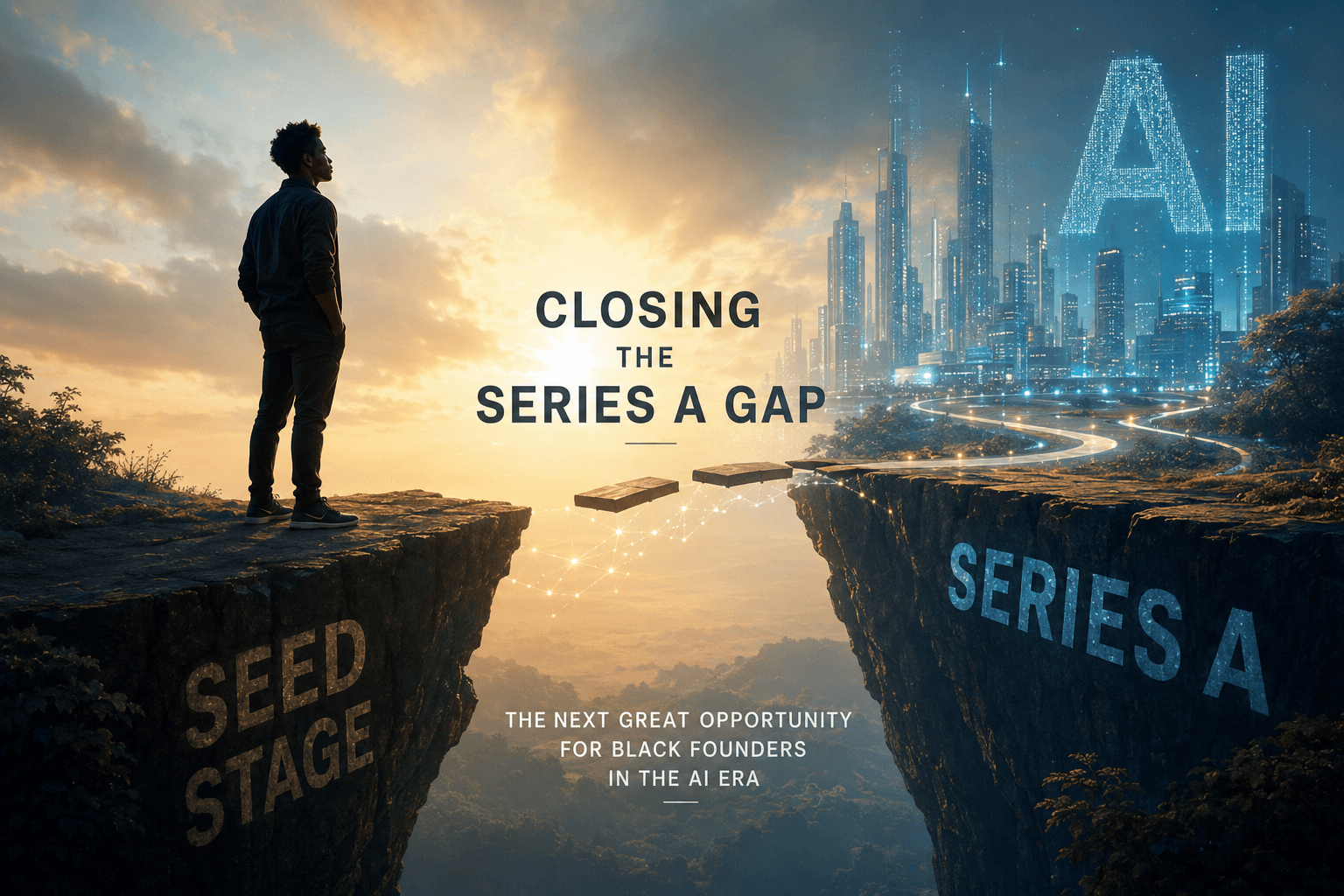
Why The Real Funding Battle For Black Founders Has Moved Past The Seed Stage
AI has made it cheaper than ever to launch a startup, but it hasn't made it cheaper to scale one — and for Black founders, that gap between an initial check and a real Series A has become the toughest hurdle of all.
A pair of venture investors argue that the defining challenge for Black entrepreneurs in 2026 isn't landing a first check anymore — it's raising a seed round large enough to actually survive the climb to Series A.
AI didn't shrink the funding gap — it relocated it
For most of the last few years, the conversation around Black entrepreneurship and venture capital centered on a simple question: could founders get in the door at all? But two venture investors now argue that framing has become outdated. As artificial intelligence reshapes how startups are built, the harder problem isn't securing an initial check — it's raising enough seed capital to actually survive long enough to earn a Series A.
Modern AI tooling has slashed the cost of building software. A five-person team can now ship products that once demanded a staff of thirty. But that efficiency only applies to the build phase. Scaling a company — acquiring customers, hiring experienced operators, funding go-to-market efforts, and hitting the growth benchmarks institutional investors expect — still costs real money. For Black founders, who already receive a disproportionately thin slice of venture funding, the inability to close a fully-funded seed round has become one of the biggest obstacles to building companies that can reach real scale.
Capital now buys proof, not just an idea
One misconception the investors push back on is the idea that startups simply need less money in the AI era. What's actually changed is when capital matters most. Because products can be built faster and cheaper, investors are rewarding demonstrated traction over polished pitches. In practice, that means seed money is no longer financing an experiment — it's financing evidence that the business works.
That shift raises the bar for what founders must accomplish before a Series A conversation even starts. Investors at that stage now expect recurring revenue, strong customer retention, capital efficiency, and repeatable growth patterns — all of which take time, disciplined execution, and enough runway to get there without constant fundraising interruptions.
The gap between "funded" and "fundable" keeps widening
The numbers underline why this matters. Black-founded U.S. startups pulled in under a billion dollars in venture capital in 2025 — a small fraction of overall national investment and a steep drop from the funding surge that followed 2021's peak. This year has brought some relief, with totals through late spring already topping the best quarter since 2022. But that rebound leans heavily on a handful of outsized deals, including a single AI-focused raise north of $300 million, rather than broad-based momentum across the ecosystem.
The deeper issue, the investors argue, isn't that capital is entirely absent — it's that many Black founders end up closing partial seed rounds that leave little operating cushion. Instead of focusing on product, customers, and hiring, those founders spend months back on the fundraising trail just to extend their runway, a cycle that costs precious time in a market where product cycles move faster than ever.
Oversubscribed rounds are becoming a survival tool
This backdrop is why oversubscribed seed rounds matter more than ever for Black founders. Traditionally viewed mainly as a sign of strong investor appetite, oversubscription is increasingly functioning as a strategic cushion. Extra capital gives founders room to withstand slower fundraising windows, move aggressively when opportunities appear, and keep executing without returning to investors every few months for another top-up. Capital efficiency still matters — but it delivers the most value when it's paired with enough capital in the first place to actually execute a plan.
Lowering the cost of starting a company doesn't eliminate the capital required to build one that lasts — and that distinction is exactly where the Series A gap for Black founders is being decided.
A longer runway, not just a bigger check
The broader point the investors make is that AI's democratizing effect on entrepreneurship is real but incomplete. It's genuinely never been easier or cheaper to launch a company. But cheaper company formation doesn't remove the capital needs of scaling one into something durable. Closing the Series A gap, in this view, isn't only about directing more dollars toward Black founders — it's about making sure those founders have enough runway to hit the specific milestones that unlock the next round of institutional capital.
The framing shift matters: rather than asking whether Black founders can get access to capital at all, the more useful question going forward is whether they have enough of it to actually compete. In an AI-driven market, the companies built by Black founders that last won't necessarily be the fastest movers — they'll be the ones with enough resources to keep building long enough to win.
- The bottleneck has shifted. The core challenge for Black founders is no longer getting a first check — it's raising enough seed capital to reach Series A.
- AI cuts building costs, not scaling costs. Cheaper product development hasn't reduced what it costs to hire, acquire customers, and grow.
- Funding remains sharply underrepresented. Black-founded startups pulled in under a billion dollars in 2025, a small fraction of total U.S. venture capital.
- 2026's rebound is uneven. Encouraging year-to-date totals are driven largely by a few outsized deals, not broad-based gains.
- Oversubscription is now a strategy. Larger seed rounds give founders the buffer to execute steadily instead of fundraising on repeat.