
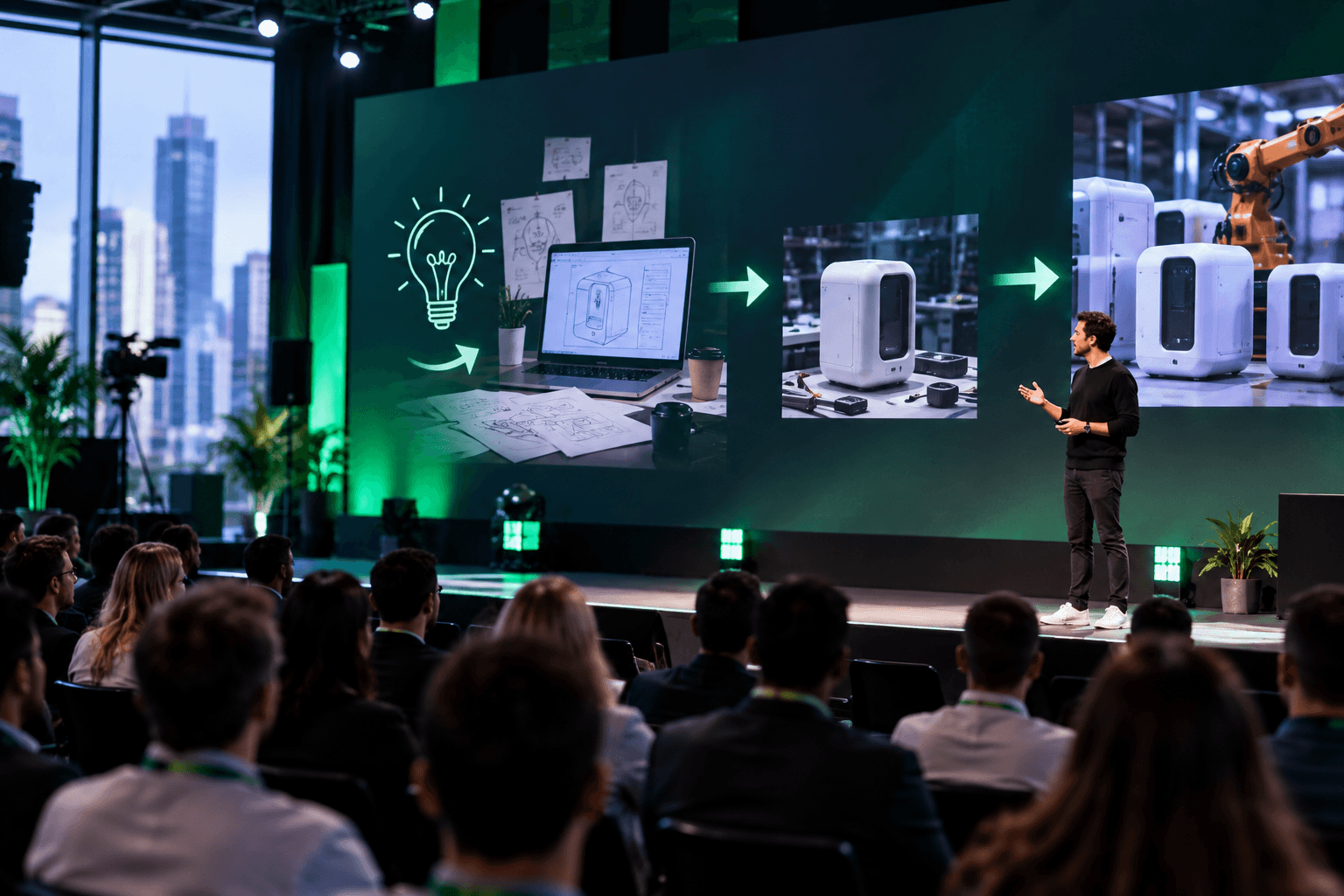
Beyond the Demo: What It Really Takes to Turn a Prototype Into a Product
AI has made impressive prototypes cheap to build, but shipping something customers can depend on is still hard. Founders from space communications, autonomous construction and robotics infrastructure show why the real work starts after the breakthrough.
A working demo proves an idea is possible. It says almost nothing about whether that idea can be manufactured, deployed and run every single day without failing. As AI shrinks the cost of building the first version, the gap between a clever prototype and a dependable product has become the place where most deep-tech startups win or lose.
The Easy Part Just Got Easier
Founders today can stand up a convincing prototype in weeks rather than years. Generative tools write code, simulate designs and stitch together demos that impress investors. But the moment that technology leaves a controlled setting, a new list of problems appears: supply chains, factory capacity, data pipelines, safety validation and the unglamorous daily work of keeping systems online.
That transition is the theme of an upcoming panel at a major San Francisco startup conference expected to draw more than 10,000 founders, investors and operators. Rather than offering a single playbook, the session puts three builders from very different industries side by side, so attendees can see where their paths diverge and, more usefully, where they overlap.
Why Production Changes Everything
Making optical communication hardware for satellites looks nothing like running autonomous excavators or driverless cars. Yet all three share one requirement: the technology must behave the same way in messy, unpredictable conditions as it did in the lab. At that stage, reliability, manufacturing and operations stop being support functions. They become part of the product itself, and customers judge the company on them.
Lessons Founders Can Apply Now
The first lesson is to plan for production early. Mackey's experience shows that building factory capability cannot wait until the design is finished; the two have to mature together, or the company stalls the moment demand arrives.
The second is that real-world performance is measured in repetition, not highlights. Sofman's background in driverless programs that accumulated over 100 million miles underlines how autonomy is proven through years of dull, consistent operation rather than one great demo.
The third is that the tools around a product matter as much as the product. Macneil's work on data platforms for autonomous fleets shows that logging, visualisation and debugging systems are what let engineering teams move from experiments to everyday deployment without losing control.
A prototype earns you attention. Production earns you trust. The startups that last are the ones that treat factories, data pipelines and uptime as seriously as the breakthrough itself.
- Prototypes are no longer the bottleneck. AI has made building a demo fast and cheap; turning it into a reliable product has not gotten easier.
- Build manufacturing alongside the technology. Waiting until the design is final leaves startups unable to meet demand.
- Reliability is the real product. Autonomous systems prove themselves through sustained, consistent operation outside the lab.
- Invest in the surrounding infrastructure. Data platforms and engineering tooling decide how far complex systems can scale.
- Learn across industries. Space, construction and robotics founders face different details but the same core transition.