
20-Year-Old's Bengaluru Startup Bets on Flight That Never Has to Land
A young founder has convinced a well-known solo investor to back a moonshot idea: small autonomous aircraft that stay airborne for a year or more by pulling energy straight out of ocean winds, borrowing a flight technique perfected by albatrosses.
Most aircraft are limited by how much fuel or battery they can carry. One young engineer in Bengaluru wants to remove that ceiling entirely by teaching a small autonomous plane to feed off the wind itself, and he's just picked up backing from a well-regarded early-stage investor to prove it can be done.
A Decision Made in Half an Hour
The startup, founded by a 20-year-old engineer, has closed a $2.5 million pre-seed round led by a prominent independent investor known for backing unconventional founders, with additional participation from an early-stage fund. According to the founder, the lead investor decided to commit within the first half hour of their initial conversation, a fast turnaround for a technology this early and this unproven.
What makes the pitch unusual is the scale of ambition attached to it. Rather than incrementally improving battery life or fuel efficiency, the company is trying to sidestep the entire problem of carrying energy onboard by extracting it directly from the atmosphere during flight.
Borrowing a Trick From Albatrosses
The approach centers on dynamic soaring, a maneuver seabirds use to travel enormous distances with barely a wingbeat by repeatedly crossing between layers of air moving at different speeds just above the ocean surface. Each crossing lets the bird, or in this case the aircraft, harvest a small amount of kinetic energy from the wind shear, which can add up over a long flight.
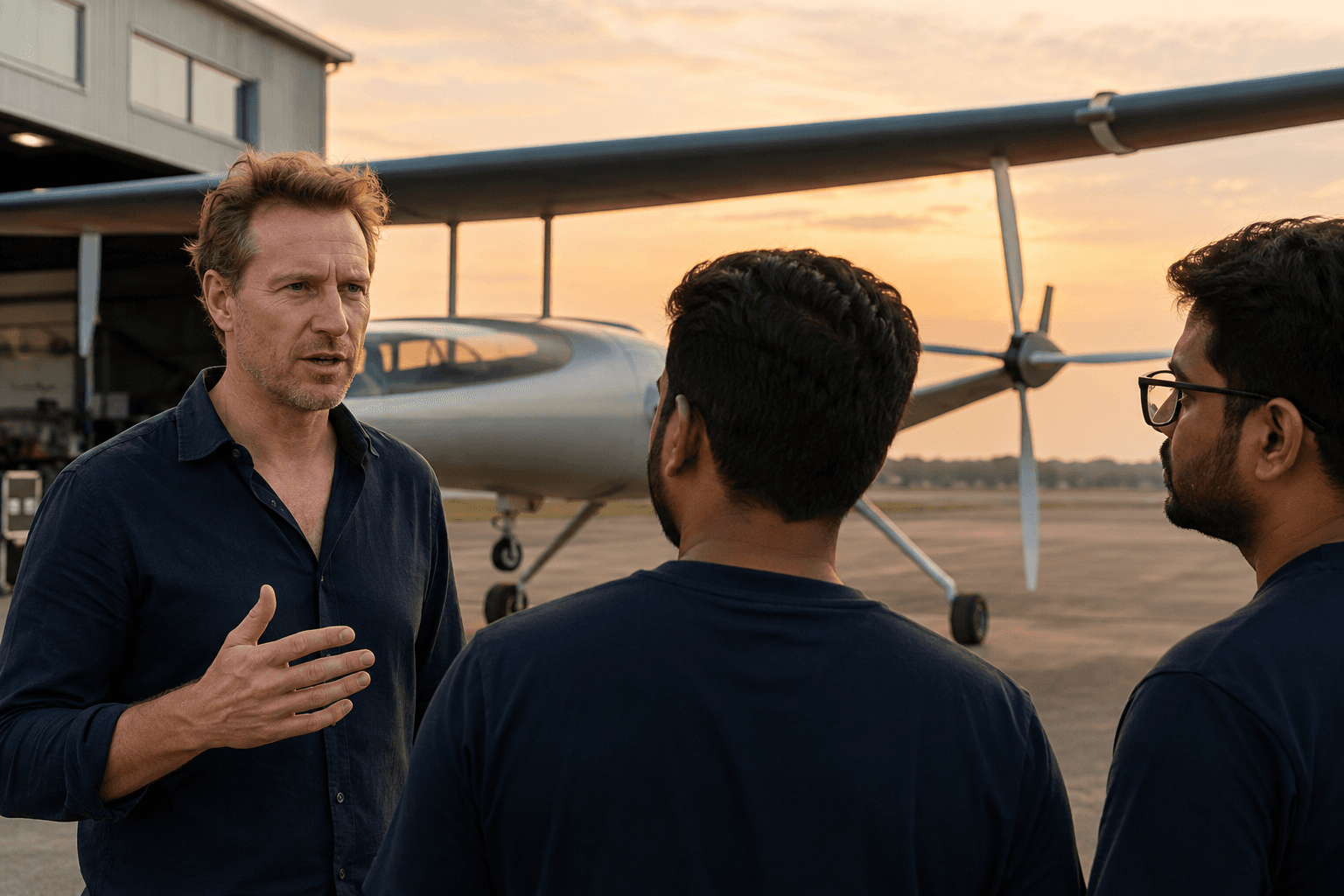
The company's small fixed-wing aircraft, with a wingspan of roughly three meters, is designed to fly close to the water, climb briefly into faster-moving air, turn, and descend again, repeating the cycle continuously. Down the line, the plan is to use its propellers as miniature turbines, converting some of that harvested energy into electricity to top up onboard batteries rather than relying on the cycle alone.
The physics behind wind-harvesting flight is well understood in theory, but turning a handful of promising low-altitude test cycles into a year-long, fuel-free mission is a leap few aerospace teams have ever attempted, let alone pulled off.
From Crashed Models to a Real Hangar
The founder's path to this point started right after high school, teaching himself to build aircraft through a long stretch of trial, error, and crashed radio-controlled models before moving on to early prototypes. He formally launched the company roughly two years later, having already secured small amounts of early support from a couple of research-minded funding programs.
The next real test for the team isn't a funding milestone but a technical one: proving what the founder calls energy-neutral flight, where the aircraft can switch off its propulsion entirely and stay airborne purely on wind energy it captures along the way. Getting there will mean contending with the messiness of real ocean conditions, including turbulence, spray, waves, and shifting light, all factors that outside researchers say could complicate the aircraft's ability to sense and react in real time. Still, even sustaining flight for a handful of days using this method alone would mark a significant milestone for the underlying science.
- A fast, high-conviction bet. The lead investor reportedly committed within 30 minutes of meeting the founder, betting on the team as much as the technology itself.
- Nature is the blueprint. The aircraft's design borrows directly from how albatrosses use dynamic soaring to travel vast distances with minimal energy expenditure.
- Early tests are promising, not proof. A successful low-altitude flight test is an encouraging first step, but sustained wind-only flight has not yet been demonstrated.
- Experts see real technical hurdles ahead. Independent researchers agree the physics is sound but flag the unpredictability of real ocean winds as the true test.
- Maritime surveillance is the entry point. Long-endurance flight could open up applications well beyond the initial use case of monitoring ocean activity for governments.