
Cosmoserve Secures $6 Million in Seed Funding
Hyderabad-based spacetech startup Cosmoserve Space has raised $6 million in a seed funding round led by Japan's Rebright Partners. The round also saw participation from Aranya Holdings and Naandi Ventures, alongside existing investors AUM Ventures and Shakti VC.
Founded by former ISRO scientist Dr. Chiranjeevi Phanindra B., the company is developing robotic spacecraft designed to capture non-operational satellites and remove them from orbit.
The startup announced the funding alongside the opening of Base 1, a new facility in Hyderabad dedicated to space debris removal and satellite servicing.
The capital will support the facility, technology demonstrations and two upcoming missions.
Hyderabad Facility to Support Space Robotics
Located at VSD Tech Park in Gachibowli, Base 1 covers approximately 14,800 square feet.
The facility includes four major areas:
Orbital Rendezvous and Capture Lab: Simulates spacecraft approach and satellite capture operations.
Space Robotics Innovation Lab: Supports the development of robotic capture systems.
ISO Class 8 Clean Room: Provides a controlled environment for satellite integration.
Mission Simulation and Control Centre: Supports mission planning, testing and operational activities.
Cosmoserve describes Base 1 as India's first private facility and the world's sixth to feature space vision effects and microgravity simulation.
Beyond removing debris, the infrastructure will also support technologies for in-orbit satellite repairs and refuelling.
Dual-Spacecraft Architecture for Satellite Servicing
Cosmoserve's technology centres on a flexible robotic capture system designed to handle irregular or tumbling objects in orbit.
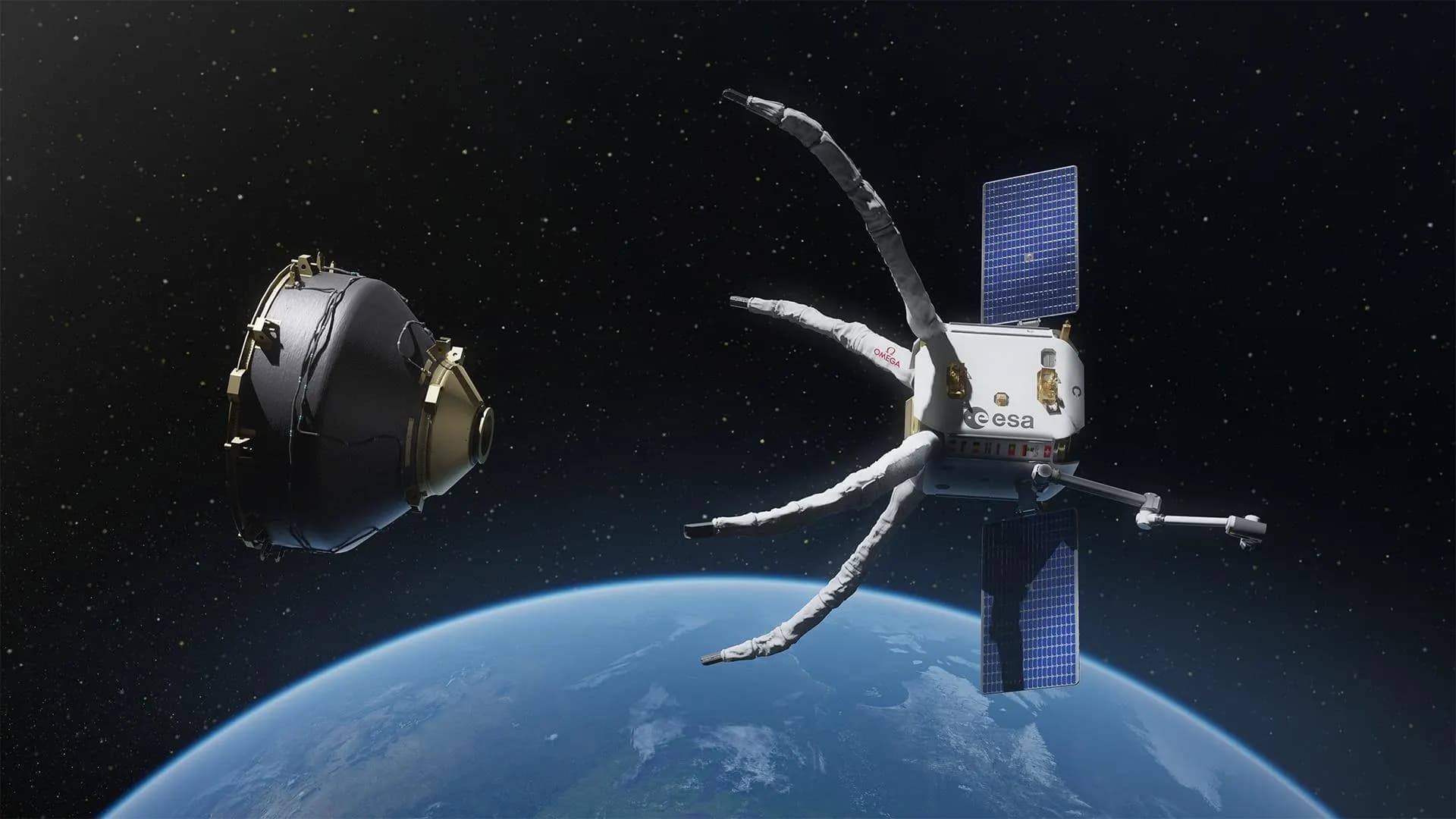
Instead of relying on conventional rigid robotic arms, the system uses flexible robotic petals that wrap around and hold target objects. The company is also developing a vision-based navigation system to support spacecraft positioning and capture.
Its proprietary Dual Spacecraft Architecture combines two vehicles:
Orbital Service Station: A larger spacecraft designed to function as an in-space logistics hub carrying fuel, equipment and spare parts.
Autonomous Service Vehicle: A smaller spacecraft designed to travel between satellites and perform capture, docking, diagnosis, repair or removal operations.
The startup estimates that this architecture could allow two spacecraft to service up to 100 satellites. It also projects that the approach could reduce servicing costs from approximately $10 million to below $1 million per satellite.
These figures represent the company's estimates rather than independently verified commercial results.
First Space Mission and Upcoming Demonstrations
In July 2026, Cosmoserve flew its first payload, Mission Embrace, aboard Skyroot Aerospace's Vikram-1 rocket.
The capture system survived the launch, and its actuation system and onboard software functioned. However, the robotic petals did not open in orbit.
The company plans to improve the capture mechanism and fly an upgraded version called Embrace-2. It also intends to conduct a full-scale debris capture demonstration in 2027, targeting an approach distance of approximately 10 metres from a non-operational satellite.
Cosmoserve is targeting commercial operations by mid-2028. According to its founder, the startup has received four letters of intent from satellite constellation operators in the US, Europe and India.
Addressing the Growing Space Debris Challenge
Space debris is becoming an increasingly important challenge as satellite launches and orbital activity expand.
Cosmoserve estimates that around 28,000 satellites are currently in orbit, of which nearly 10,000 are dead or non-operational. The company also estimates that approximately 660 collisions and explosions have generated nearly 58,000 tracked debris fragments.
Founded in June 2025, Cosmoserve is building on its founder's approximately 15 years of experience at ISRO, including work on India's Gaganyaan human spaceflight programme.
The company's development reflects India's expanding private space sector and the growing need for technologies that support safer, more sustainable orbital operations.